


You are now reading:
Why Asia, why now? Rethinking Asia's place in global portfolios

Tel:
• 6532 7988
Complaint Management
• Hotline: 1800 22 22 228
• Calling from overseas: +65 6222 2228
Tel:
• 6532 7988
Complaint Management
• Hotline: 1800 22 22 228
• Calling from overseas: +65 6222 2228
Tel:
• 6532 7988
Complaint Management
• Hotline: 1800 22 22 228
• Calling from overseas: +65 6222 2228
Tel:
• 6532 7988
Complaint Management
• Hotline: 1800 22 22 228
• Calling from overseas: +65 6222 2228

you are in UOB Asset Management


You are now reading:
Why Asia, why now? Rethinking Asia's place in global portfolios
The first article in our Asia series, this piece sets out the case for a strategic allocation to Asia, exploring the market and macroeconomic factors that make the region attractive today.
For much of the past decade, global investors focused heavily on the US. Strong economic growth, robust earnings and the rise of the Magnificent Seven tech companies attracted significant capital into US markets.
But with US market concentration reaching historically elevated levels, valuations becoming demanding, and global leadership broadening beyond a handful of megacap tech companies, investors are increasingly looking beyond the US for diversification and new sources of return.
Against this backdrop, Asia is emerging as one of the most compelling opportunities for global investors. From structural growth themes and innovative industry leaders to income-generating companies, the region offers a diverse set of opportunities that can play multiple roles within a portfolio. More importantly, a supportive macroeconomic backdrop, accelerating earnings growth, attractive valuations, and the prospect of renewed capital flows are creating a timely opportunity for investors to increase their exposure to Asia.
One of the most important shifts underway in global markets is the potential beginning of a multi-year US dollar weakening cycle, driven by factors such as fiscal concerns, policy uncertainty, and weakening trust in the dollar’s role as a global reserve currency.
Historically, periods of US dollar weakness have been supportive for emerging market assets, as a softer dollar tends to improve liquidity conditions, support capital inflows, and create a more favourable environment for corporate earnings.
Analysis of previous market cycles shows that emerging markets outperform developed markets by an average of about 10.4 percent during periods of dollar weakness1. In fact, a declining US dollar combined with stronger emerging market growth historically enabled the region to significantly outperform developed markets.
| Start date | End date | Dollar cycle | GDP differential cycle between EM and DM | Excess annualised return (EM-DM) |
| Jan 1996 | Dec 1998 | Strengthening | Narrowing | -29.5% |
| Jan 1999 | Feb 2002 | Strengthening | Widening | 9.6% |
| Mar 2002 | Dec 2009 | Weakening | Widening | 13.1% |
| Jan 2010 | Jul 2011 | Weakening | Narrowing | 2.0% |
| Aug 2011 | Dec 2021 | Strengthening | Narrowing | -8.3% |
| Jan 2022 | Jan 2025 | Strengthening | Widening | -8.7% |
| Feb 2025 | Dec 2025 | Weakening | Widening | 16.2% |
Source: FactSet, State Street Investment Management, as of Dec 2025. Excess annualised returns show the emerging market (EM) relative performance over developed market (DM). Past performance is not indicative of future returns.
Today, a softer US dollar and stronger growth prospects across emerging markets suggest that a similarly supportive environment may be taking shape. Given that Asia represents approximately 85 percent of the MSCI Emerging Markets Index, this could create a potentially favourable backdrop for emerging markets and Asia.
This trend has already begun to emerge. Asian equities have outperformed both US and global markets over the past two years as a weakening US dollar, strong earnings growth and robust artificial intelligence (AI) demand supported the region's performance.
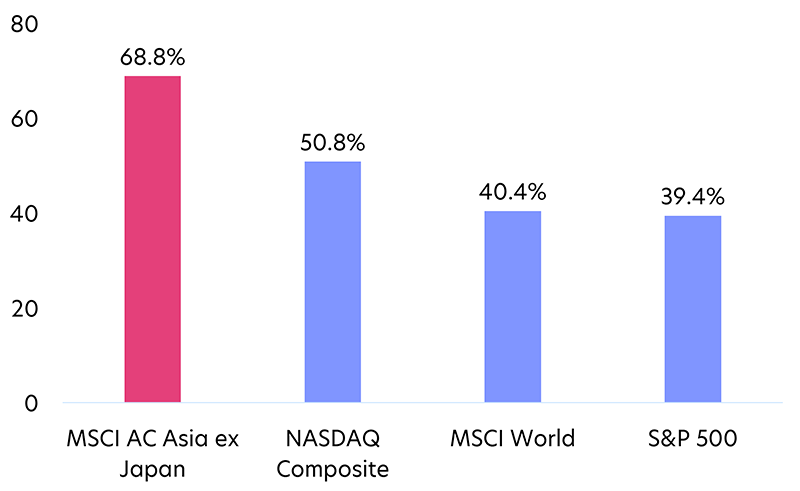
Source: UOBAM, Bloomberg. Data from 30 August 2024 – 31 August 2026, in total return terms (USD). Past performance is not indicative of future returns.
Looking ahead, we believe the ongoing diversification away from the US dollar could continue, creating the conditions for a prolonged period of dollar weakness. If this scenario unfolds, it could provide a powerful tailwind for Asian assets in the years ahead.
Some investors worry that Asia’s strong outperformance over US and global markets over the past two years means that they have missed their chance. We take a different view.
Despite recent gains, Asian corporate earnings have grown even faster than share prices. As a result, Asia ex-Japan currently trades at around 10 times forward earnings, well below its long-term average of 13 times, leaving valuations near the lower end of their historical range2.
The opportunity becomes even more compelling when viewed relative to global markets. Earnings growth in Asia ex-Japan has accelerated sharply in recent years and now exceeds that of global equities. Despite this, the region trades at a roughly 45 percent discount to global markets on a forward P/E basis, one of the widest discounts seen in the past decade3.
With valuations near historical lows despite strong earnings momentum, current levels offer attractive upside potential should earnings continue to grow and sentiment towards the region continue to improve.
Global portfolios today remain concentrated in US equities after years of outperformance. However, as investors seek broader sources of return and diversification, attention is increasingly turning towards emerging markets.
A recent Franklin Templeton survey highlights this shift. 50 percent of UK wealth managers polled view emerging markets as the most attractive equity opportunity over the next 12 months, while 60 percent plan to increase their exposure4, underscoring the potential for renewed capital flows into the asset class.
Given Asia's dominant representation within emerging market indices, a substantial proportion of those flows are likely to find their way into Asia. As investors diversify away from increasingly concentrated US exposures, Asia stands to benefit from both dedicated Asia allocations and broader emerging market mandates, providing an additional tailwind for Asian equities.
Taken together, a potentially weaker US dollar, improving earnings momentum, the prospect of renewed capital flows and attractive valuations create a compelling case for investors to revisit Asia today.
We’ve set out the investment case for Asia above. But how should investors actually approach investing in Asia? After all, the region is not one monolithic bloc. It encompasses innovation-driven economies such as Korea and Taiwan, rapidly expanding consumer markets such as India and Southeast Asia, as well as sophisticated financial centres including Singapore and Hong Kong.
One useful framework is to think about investing in Asia through three powerful engines: Growth, Innovation, and Income.
Asia is home to some of the world's fastest-growing economies. The region has become an increasingly important driver of global growth, accounting for one-third of global GDP and 56 percent of all listed companies5. While the number of listed companies in the US and Europe has shrunk, listed companies in Asia have nearly doubled to about 29,000 companies between 2000 and 20246.
The region's growth story is underpinned by powerful structural trends. By 2030, Asia could be home to two-thirds of the global middle class, according to McKinsey. Rising incomes are driving demand for higher-quality goods and services across sectors such as consumer goods, healthcare, financial services and digital payments.
Meanwhile, ongoing urbanisation, infrastructure investment and industrial development are generating demand across a wide range of industries, from industrials and commodities to transportation and utilities.
Together, these trends are creating an opportunity set of considerable scale and breadth, creating multiple pathways for investors to participate in Asia’s long-term growth.
Beyond its growth potential, Asia is increasingly establishing itself as a global innovation hub. Governments across the region are investing heavily in strategic industries, while rising research and development (R&D) spending is strengthening capabilities in advanced technologies and high value-added manufacturing. Asia now accounts for about 45 percent of global R&D spending, up from around 23 percent in 20007, underscoring the region's growing role in shaping the technologies of the future.
Today, Asian companies play critical roles in global supply chains spanning semiconductors, electric vehicles, robotics, advanced manufacturing, AI and clean energy technologies. For investors, this opens access to a diverse set of companies that are not only benefiting from Asia's economic growth but also enabling the next generation of global innovation.
Asia is often viewed through the lens of growth, but the region also offers compelling income opportunities, particularly in ASEAN. Across ASEAN, many established companies benefit from strong balance sheets and resilient cash flows, enabling them to deliver sustainable dividend payouts to shareholders.
Attractive dividend opportunities can be found across sectors such as financials, telecommunications, utilities and consumer staples, providing exposure to businesses with durable competitive advantages and strong links to domestic growth.
Importantly, these companies can offer a combination of regular income and long-term capital appreciation. This can help investors build more resilient portfolios while remaining invested through periods of market volatility.
From established economies and mature companies to fast-growing markets and emerging industries, Asia offers multiple sources of growth, innovation and income.
This breadth allows investors to build exposure aligned with their own investment objectives, whether they are seeking long-term capital appreciation, portfolio diversification, income generation, or a combination of all three.
Successful investing in Asia requires more than identifying attractive opportunities. It requires deep local knowledge, on-the-ground research and the ability to navigate a region that is diverse, complex and constantly evolving.
With 40 years of investment experience in Asia8, UOB Asset Management combines regional expertise with local market insights to uncover opportunities across the region's growth, innovation and income landscape.
Our team of more than 80 investment professionals is embedded across nine key Asian markets9, providing investors with first-hand insights into local economies, industries and companies. This on-the-ground presence enables us to identify opportunities early and navigate market developments with greater conviction.
Over the years, our investment capabilities and commitment to delivering outcomes for clients have been recognised through more than 400 industry awards10, reflecting our long-standing track record across the region.
Whether investors are seeking broad exposure to Asia, targeted access to specific opportunities or income-focused strategies, UOBAM offers a range of solutions designed to help investors participate in the region's long-term potential.
Explore UOBAM’s Asia investment solutions
1Source: FactSet, State Street Investment Management, as of Dec 2025
2Source: UOBAM, Bloomberg, as of 8 Sep 2026
3Source: UOBAM, Bloomberg, as of 8 Sep 2026
4Funds Europe, UK investors boost emerging markets allocation, survey shows, 10 August 2026
5Source: Asia Capital Markets Report 2026, OECD
6Source: Asia Capital Markets Report 2025, OECD
7Source: Despite the Odds, Global R&D Spending Grew Again in 2024, Inching Closer to the USD 3 Trillion Mark, WIPO, Dec 2025
8Source: UOBAM, as of 30 June 2026
9Source: UOBAM, as of 30 June 2026
10Source: UOBAM, as of 30 June 2026. Please refer to uobam.com.sg/awards for the latest list of UOBAM awards.

10 Sep 2026 • 13 mins watch

28 Aug 2026 • 5 mins read