




 Watch Video
You are now reading:
Why Asia deserves a rethink

Tel:
• 6532 7988
Complaint Management
• Hotline: 1800 22 22 228
• Calling from overseas: +65 6222 2228
Tel:
• 6532 7988
Complaint Management
• Hotline: 1800 22 22 228
• Calling from overseas: +65 6222 2228
Tel:
• 6532 7988
Complaint Management
• Hotline: 1800 22 22 228
• Calling from overseas: +65 6222 2228
Tel:
• 6532 7988
Complaint Management
• Hotline: 1800 22 22 228
• Calling from overseas: +65 6222 2228

you are in UOB Asset Management
You are now reading:
Why Asia deserves a rethink
From consumption to commodities, Asia’s opportunity set extends well beyond AI.
Asia’s market narrative has increasingly been dominated by discussions around AI, tech, and semiconductors. While these remain important growth drivers, the region’s opportunity set is far broader.
From rising consumption and growing commodity demand to technological innovation and attractive dividend-paying companies, Asia offers a compelling mix of growth, income and diversification.
We sat down with Paul Ho, Group Head of Asia ex-Japan Equities at UOBAM, to discuss why Asia deserves a fresh look, his view on the AI trade, and where investors may find overlooked opportunities across the region.


Jason Teo: For years, investors have been urged to invest in Asia, but it is only in recent years that Asian markets have gained significant momentum. What has changed to drive this shift?
Paul Ho: I think to answer the question on why Asia, especially why Asia now, it's important to take a step back and look at the broader context of what is happening in the rest of the world.
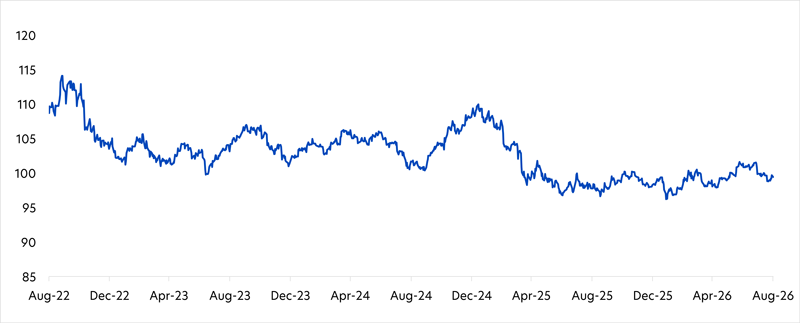
If you look at the bigger trends, for instance, the US dollar trend, that is one very big historical factor that affects fund flows to and from Asia. Historically, when the US dollar is weak, two things tend to do very well.
The first is emerging markets, and emerging markets largely means Asia because 80 percent of the emerging markets index is Asia. So, what we're saying is when the US dollar is weak, Asia tends to do well, and that's what has happened since the 1960s.
Fig 1: US Dollar Index (DXY) has been on a downtrend in recent years
Source: UOBAM, Bloomberg. Data from 30 August 2022 - 31 August 2026
Now the second thing that does well when the dollar is weak is commodities. We think there's opportunity here in Asia for some of the commodity plays.
If you believe that in the next couple of years, the US dollar is going to continue to be weak – and there are many reasons to believe so – then I think there will be a very strong tailwind for Asian investing.
Jason: Many investors have portfolios heavily concentrated in US equities. What role can Asia play in a diversified portfolio?
Paul: I've been investing in Asia for close to 30 years, and one rule that I live by is diversify, diversify, diversify.
I think it's a good time to diversify out of the US. Asia is one area you can consider because the region has some of the fastest growth rates in the world. And now with this AI boom, people are starting to discover again that most of the AI hardware is manufactured in Asia, making Asia the AI enabler of the world.
We have many fantastic companies, like TSMC, Samsung Electronics, SK Hynix. They're all based in Asia, not to mention many other component companies in Taiwan and in China that will benefit. So that's I think that's one of the main reasons why people should look at Asia to diversify away from the US.
In Asia, we also have a group of countries called ASEAN, our own backyard, and based on our studies, we discovered ASEAN has very little correlation to US markets and for that matter, China markets.
So, if your investors are invested in the US and in China, adding ASEAN to the portfolio is a good diversifier, according to traditional portfolio management theory. It increases your long-term return without taking additional risk.
From that aspect I think all investors should diversify away from putting all your eggs in one basket, no matter what the basket.
Jason: Asia is often viewed as one of the world's key growth regions. What are the most compelling investment themes you see across Asia today?
Paul: I think there's no escape from tech because if you look around the world, it's very clear that this AI boom that we are seeing is going to last for many years. Not just two or three years, but maybe even 10 or 20 years.
Some people have called this AI revolution the fourth industrial revolution for mankind. Asia sits right in the middle of this revolution. I just mentioned the word enabler, so we make the hardware that makes all these things possible.
And a lot of these companies are world leaders in what they do, and in fact, if you look along the value chain, we have companies that have little to few competitors in the product that they make.
TSMC, for instance, is effectively the only company that makes high-end chips in the world. You have memory companies, I also mentioned earlier, Samsung Electronics and SK Hynix, that make DRAMs. Effectively I think three companies in the world produce most of the world's DRAMs.
So these companies will be the best beneficiaries of this AI revolution. If the demand for AI grows, all this money that's channelled into this revolution will have to go to these companies, right? So in many ways it's much easier to pick winners of the AI revolution in Asia.
China is another special case because for China to catch up with the US, they have to invest even more. And because of all the technology sanctions on China in the last couple of years, they have no choice but to develop their own supply chain. That is also heavily supported by the government. So again, there are unique opportunities that only Chinese AI hardware companies can benefit from. So, if you want to benefit from both China AI spending and US AI spending, the Asia tech chain is uniquely positioned.
Jason: Other than AI, are there any other investment themes that you like in Asia?
Paul: You're right Jason, that Asia is not just about AI; we have other investment themes.
Most of us know that Asia, or in particular ASEAN, is actually one of the youngest regions in the world. So as the young people become middle aged, they tend to have increased income, so they will spend more on housing, on cars, on kids, and all sorts of things.
That provides a lot of opportunities for Asian consumer companies, like Asian brands, you know brands that they're familiar with, brands that they grew up with that's different from the Western brands. So, I would say in the longer term, I think Asian consumer companies might do quite well.
Now, a derivative of this AI boom is actually the demand for commodities. That’s something that again, not many people talk about. But in order to make stuff, you actually need commodities, like copper, the wire that goes in that connects all the machines together, or maybe even aluminium and silver. You've heard so many other rare earths that are in shortage right now, because of all this growth in AI, in technology, in semiconductors.
So there are a lot of opportunities. I think a lot of people forget that actually Asia also has many commodity companies. In fact, in our funds, we do invest in aluminium companies, zinc companies, gold companies, copper companies.
The story here is that there hasn't been a lot of money going into this sector for a long time. A lot of money has gone to tech. And it takes maybe 5, 10, 15 years to develop a mine. So 10 years ago, if the money had gone to tech, and they had not gone to mining, you can be sure that ten years later there wouldn't be additional supply.
This is the situation we are seeing now, with all the increased demand, and, you know, the lack of investment 10, 15 years ago. We are seeing a shortage of supply now, and hence I think over the next couple of years we should see many of these commodities increasing their price and doing quite well. So, a lot of Asian commodity companies will benefit.
Now the third area that people don't normally talk about investing in Asia is the income aspect. From our own studies, we were pleasantly surprised to know that ASEAN is one of the very few high dividend-paying regions in the world.
Our companies have a long history of paying out dividends; you only have to look at Singapore banks for example. They are well known for paying a lot of dividends, but they're not the only ones. Indonesian banks, Indonesian utilities, even Indonesian consumer companies pay very decent dividends.
And the reason is because their business is doing quite well, they're generating cash flows and they're returning the cash flow to investors in the form of dividends. So that's one area I think we can look at especially in times like this.
We know that there's a lot of uncertainty in the world right now. It doesn't hurt to have a part of your portfolio generating income to help you tide through this volatility.
Jason: We saw a major pullback within the Asia tech sector in July. How do you separate a short-term market correction from genuine changes in the long-term outlook for AI and tech investment?
Paul: That's quite a difficult question, but I would share with you how we analyse the situation along three dimensions: fundamentals, valuations and positioning.
Let me look at the fundamentals first. I think we have spent enough time looking at the data and I think we are quite confident to say that the fundamentals are quite solid. We think that a lot of these companies, not all companies, but quite a lot of companies, especially in Asia, they going to generate pretty good cash flows in the next couple of years.
We think that this growth will continue for quite a while and the growth is not a low growth rate. It’s quite high compared to the historical growth rate we've seen. So fundamentally, I think a lot of these companies will do quite well.
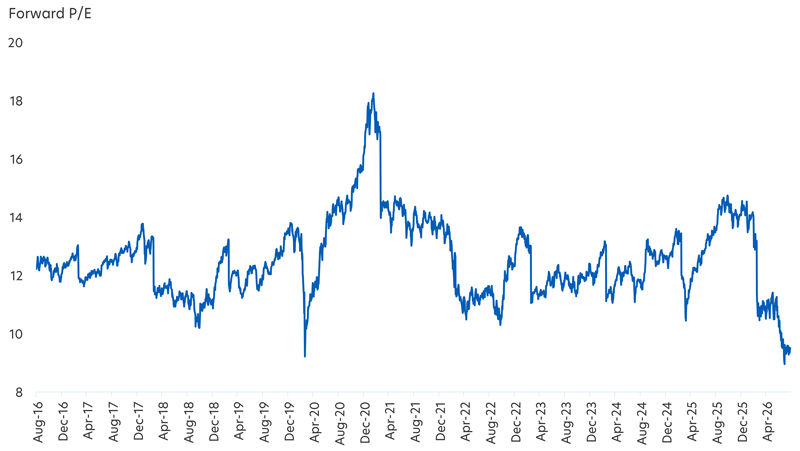
Now, on the valuations. If you look at the data, I think Asia has outperformed the US by quite a good margin in the last two years.
But I would say that most investors are only focused on the price increase, but what they fail to see is that the earnings have gone up much faster than the price. So, when you look at the valuation, let's say the price to earnings ratio, if earnings are going up faster than price then, paradoxically, the PE is lower today than what it was 12 months ago.
Fig 2: MSCI Asia ex Japan valuations look attractive and currently sit below their long-term average
Source: UOBAM, Bloomberg, as of 31 August 2026
So rather paradoxically, if you invest today, you are investing cheaper than investors who have done so let's say one year ago. So valuation wise I think it's quite attractive. It's low and it's gone lower and of course with the July correction it's gone even lower.
Now, the third aspect is the one that's a bit more problematic. The positioning in the market. Now, we have heard a lot of stories about you know Korean investors, even Taiwanese investors borrowing a lot of money to buy stocks.
The leverage by domestic retail investors have gone out lot but that's not the full story. If you take a step back and you look at all the components of funds flow, domestic retail is just one part and it's not the biggest part. In fact, if you look at foreign fund flows, there has been a huge outflow of foreign funds from Asia and more specifically Korea and Taiwan.
In other words, investors around the world in aggregate, they have been pulling money out of Asia, even though we have done so well, earnings have done so well, and valuations are so cheap now.
Yes, I think in July after the selldown we do see a bit more of the inflows coming from foreign foreigners. But this is just a drop in the ocean, so overall what we see is that the foreign investors are still very much underweight Asia.
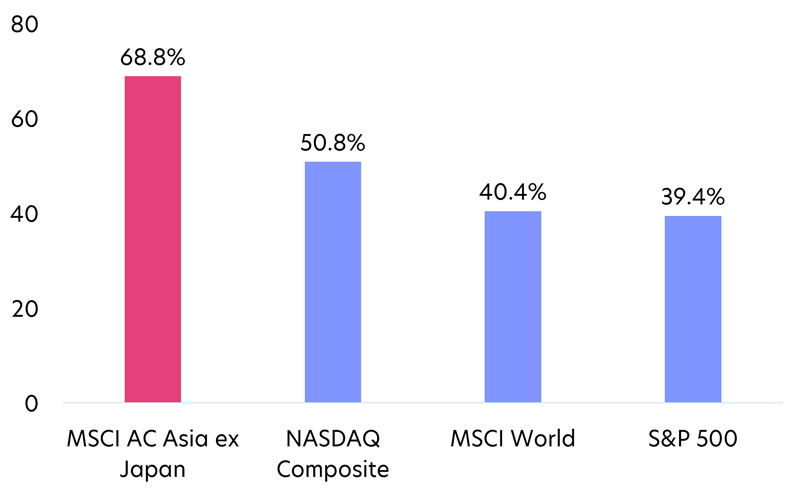
And Jason, let me tell you why that's important. Because for the bull market to continue, I always say that you need fresh money. Where's the fresh money going to come from? That's your answer. The fresh money is going to come from big foreign funds that have been underweight and they have possibly missed out on the rally in the last two years. In the last two years, Asia has outperformed both the S&P 500 and the NASDAQ Composite.
Fig 3: Asia has outperformed global and US markets over the past 2 years
Source: UOBAM, Bloomberg. Data from 30 August 2024 – 31 August 2026, in total return terms (USD). Past performance is not a guarantee of future returns.
Maybe after this podcast, more people will realise that the earnings are growing much faster, and valuations are much cheaper. It's something that could make them reassess the investment opportunities and then hopefully we'll see much more fund flows our way.
Jason: To end our discussion, what are some principles guiding your investment decisions as you navigate today's uncertain market environment?
Paul: I think when you talk about uncertainty, you also have to look at the extraordinary volatility that we've just experienced. One of the things that we do need to pay attention to is risk management. We spend a lot of time thinking about how to preserve capital for our investors. It's fine to make lots of money when the markets are going up, but we know that the correction is always around the corner. You know, we just saw one very big one in July. And so it's important for us to not take too much risk when the times are good. Yes, maybe you are not the top performer in that particular month of the particular year, but it's important not to take excessive risk.
We have a very robust set of risk control measures to make sure we don't do that and that we play for the long term, and we play both attack and defense. In soccer terms, we cannot just be attacking all the way.
When the markets are bad and inevitably there will be times when the markets are not doing well, we guard the assets of our investors so that when markets are good again, we have enough capital to be deployed for the next round.

28 Aug 2026 • 5 mins read

13 Aug 2026 • 4 mins read