


You are now reading:
The AI trade is evolving. Where are the opportunities in Asia?

Tel:
• 6532 7988
Complaint Management
• Hotline: 1800 22 22 228
• Calling from overseas: +65 6222 2228
Tel:
• 6532 7988
Complaint Management
• Hotline: 1800 22 22 228
• Calling from overseas: +65 6222 2228
Tel:
• 6532 7988
Complaint Management
• Hotline: 1800 22 22 228
• Calling from overseas: +65 6222 2228
Tel:
• 6532 7988
Complaint Management
• Hotline: 1800 22 22 228
• Calling from overseas: +65 6222 2228

you are in UOB Asset Management


You are now reading:
The AI trade is evolving. Where are the opportunities in Asia?
After a meteoric rise in the first half of 2026, tech stocks across Asia came under pressure in July as investors questioned whether the massive investments being poured into AI would ultimately translate into sustainable returns. Foreign investors pulled $25.5 billion from Asian equities during the month, with the selling concentrated in tech- and semiconductor-heavy markets such as Taiwan and South Korea.
With the volatility extending into August, this has understandably raised questions about whether Asia’s AI rally has run its course.
While we think near-term uncertainty is likely to persist, still-solid fundamentals lead us to believe that the AI investment cycle remains intact. AI remains one of the most transformative technologies today, with the potential to reshape industries, business models and productivity.
Asia, in particular, is uniquely positioned to benefit. The region sits at the centre of several critical segments of the AI value chain, from Korean memory manufacturers and Taiwanese semiconductor leaders to China's rapidly advancing technology ecosystem and select Indian IT services providers.
That said, the AI trade is becoming more nuanced. Markets are becoming more discerning and understanding where value is being created within Asia will become increasingly important for investors. In this environment, active management plays a critical role in identifying the most compelling opportunities while managing downside risk.
Before exploring where we see opportunities in Asia today, it is worth revisiting the fundamentals underpinning the AI investment cycle.
In our view, the recent AI and tech sell-off has been largely driven by the unwinding of crowded positioning and leverage, rather than a deterioration in underlying fundamentals.
Second-quarter earnings from many AI and semiconductor companies were broadly resilient, and major hyperscalers raised capital expenditure plans following their results, signalling that investment in AI infrastructure remains a top priority.
Underlying demand trends help explain this commitment. Anthropic’s annualised revenue run rate of $65 billion at the end of July 2026, a sevenfold increase from a year ago, underscores rapid growth in AI activity and computational demand. As AI applications become more deeply embedded into consumer and enterprise workflows, infrastructure requirements are likely to remain substantial.
In the earlier stages of the AI cycle, investors tended to reward companies producing the most advanced frontier AI models. Today, that advantage is increasingly being challenged as Chinese developers rapidly narrow the capability gap, achieving competitive global rankings despite restrictions on access to cutting-edge chips. China’s Moonshot AI comes to mind, with its Kimi K3 model ranking fourth among AI models worldwide1.
Furthermore, many leading Chinese models are priced more affordably than their US counterparts, with the added benefit of being available through open-source frameworks. This has reduced differentiation among large language model (LLM) providers and weakened pricing power at the model layer.
As model capabilities converge, the winners increasingly become the companies that can support massive AI adoption at scale, not necessarily those with the most advanced model. Infrastructure owners, semiconductor suppliers and memory manufacturers stand to benefit from sustained growth in AI workloads regardless of which LLM provider ultimately gains market share.
In July, reports that China has begun mass producing immersion deep-ultraviolet (DUV) lithography machines, a key piece of semiconductor manufacturing equipment, reignited fears that Chinese memory producers could soon accelerate capacity expansion. This would intensify competition in the global memory market, potentially leading to increased pricing pressures.
While China's progress is undoubtedly encouraging, we believe these concerns may be overstated. Producing advanced lithography equipment is only one part of a highly complex semiconductor ecosystem. Leadership at the cutting edge still depends on a network of specialised technologies spanning EUV lithography, precision optics, advanced materials, process control and manufacturing equipment, many of which remain dominated by a handful of global players and have few viable substitutes.
Given that key technological chokepoints remain difficult to replicate, we therefore view concerns about an imminent shift in industry leadership or a rapid erosion of competitive advantages as premature.
The AI investment cycle remains intact, but not all parts of Asia's technology sector are equally attractive. As the market increasingly differentiates between companies, business models and segments of the AI value chain, we believe a selective approach is required. This is reflected in our positioning across Asia today.
We continue to see attractive opportunities in Korea's tech sector, particularly among advanced memory chipmakers. As AI models become increasingly sophisticated and memory-intensive, demand for advanced memory solutions has surged, driving prices higher and reinforcing our view that memory remains one of the most compelling segments of the AI value chain.
While current earnings are still largely supported by contract pricing, contract prices appear to have further room to rise as they catch up with spot market trends. Recent earnings results have also pointed to a growing mix of longer-term supply agreements, providing greater earnings visibility for leading memory producers such as SK Hynix and Samsung Electronics.
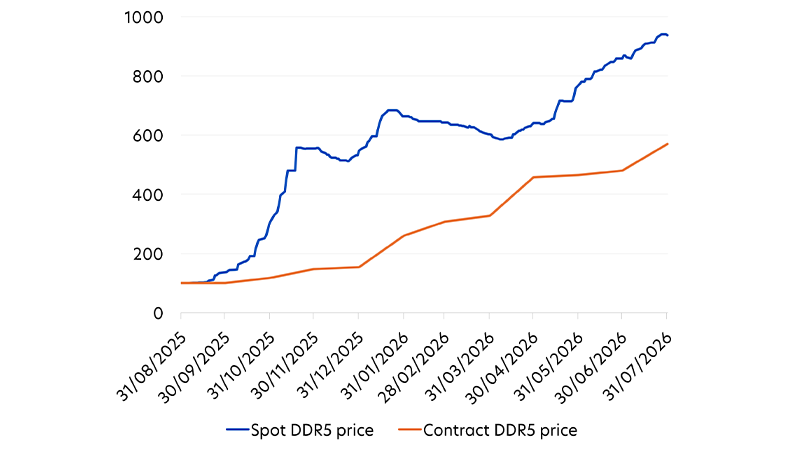
Source: UOBAM, Bloomberg, inSpectrum, as of 6 Aug 2026
Recent market volatility has further strengthened the investment case for Korean tech stocks. The sharp correction in July helped unwind excess positioning, particularly in leveraged technology ETFs, leaving valuations significantly more attractive despite earnings remaining near record highs. With Korea tech now trading at less than four times earnings2 and continuing to benefit from strong AI-driven demand, we believe Korea currently offers one of the most attractive risk-reward opportunities within Asian tech markets.
Taiwan remains at the centre of the global AI supply chain and is home to many of the world's leading semiconductor companies. Industry fundamentals remain robust, with monthly semiconductor revenues continuing to accelerate as demand across the AI ecosystem stays strong.
While we remain constructive on the sector's long-term prospects, much of this optimism already appears reflected in valuations. Despite the recent correction, Taiwan’s tech sector continues to trade at close to 20 times earnings3, above their long-term average. As a result, we do not yet see sufficient valuation support given the uncertainty surrounding the next phase of the AI investment cycle.
China continues to offer compelling long-term opportunities, particularly in areas such as AI and innovation. The recent correction has also brought valuations down to more reasonable levels, moving them closer to the middle of their historical range.
While this is an improvement from previously elevated valuations, we do not yet view the sector as particularly attractive on a valuation basis. As a result, we remain close to neutral in our positioning, maintaining a marginal underweight to China tech.
We are overweight India IT services, particularly agile mid-cap companies that have moved quickly to capitalise on rising enterprise AI adoption and are now emerging as early beneficiaries of the trend.
Earlier this year, investor sentiment towards the sector became overly pessimistic, driving valuations to attractive levels even as earnings remained resilient. We increased our exposure several months ago, and the position has been a positive contributor to portfolio performance.
As AI adoption broadens beyond infrastructure and into enterprise deployment, we see growing opportunities for IT services firms that help clients implement, integrate and scale AI solutions.
1Source: UOBAM, artificialanalysis.ai, data as of 5 Aug 2026
2Source: UOBAM, Bloomberg, MSCI, as of 6 Aug 2026
3Source: UOBAM, Bloomberg, MSCI, as of 6 Aug 2026

MSCI Data are exclusive property of MSCI. MSCI Data are provided “as is”, MSCI bears no liability for or in connection with MSCI Data. MSCI full disclaimer at msci.com/notice-and-disclaimer-for-reporting-licenses.
All information in this publication is based upon certain assumptions and analysis of information available as at the date of the publication and reflects prevailing conditions and UOB Asset Management Ltd (“UOBAM”)'s views as of such date, all of which are subject to change at any time without notice. Although care has been taken to ensure the accuracy of information contained in this publication, UOBAM makes no representation or warranty of any kind, express, implied or statutory, and shall not be responsible or liable for the accuracy or completeness of the information.
Potential investors should read the prospectus of the fund(s) (the “Fund(s)”) which is available and may be obtained from UOBAM or any of its appointed distributors, before deciding whether to subscribe for or purchase units in the Fund(s). Returns on the units are not guaranteed. The value of the units and the income from them, if any, may fall as well as rise, and is likely to have high volatility due to the investment policies and/or portfolio management techniques employed by the Fund(s).
Please note that the graphs, charts, formulae or other devices set out or referred to in this document cannot, in and of itself, be used to determine and will not assist any person in deciding which investment product to buy or sell, or when to buy or sell an investment product. An investment in the Fund(s) is subject to investment risks and foreign exchange risks, including the possible loss of the principal amount invested. Investors should consider carefully the risks of investing in the Fund(s) and may wish to seek advice from a financial adviser before making a commitment to invest in the Fund(s). Should you choose not to seek advice from a financial adviser, you should consider carefully whether the Fund(s) is suitable for you. Investors should note that the past performance of any investment product, manager, company, entity or UOBAM mentioned in this publication, and any prediction, projection or forecast on the economy, stock market, bond market or the economic trends of the markets is not necessarily indicative of the future or likely performance of any investment product, manager, company, entity or UOBAM or the economy, stock market, bond market or economic trends of the markets. Nothing in this publication shall constitute a continuing representation or give rise to any implication that there has not been or that there will not be any change affecting the Funds. All subscription for the units in the Fund(s) must be made on the application forms accompanying the prospectus of that fund.
The above information is strictly for general information only and is not an offer, solicitation advice or recommendation to buy or sell any investment product or invest in any company. This publication should not be construed as accounting, legal, regulatory, tax, financial or other advice. Investments in unit trusts are not obligations of, deposits in, or guaranteed or insured by United Overseas Bank Limited, UOBAM, or any of their subsidiary, associate or affiliate or their distributors. The Fund(s) may use or invest in financial derivative instruments and you should be aware of the risks associated with investments in financial derivative instruments which are described in the Fund(s)’ prospectus.
This advertisement has not been reviewed by the Monetary Authority of Singapore.
UOB Asset Management Ltd Co. Reg. No. 198600120Z