





Paul Ho
Group Head of Asia ex Japan Equities
Over the past weeks, global markets have been rocked by escalating geopolitical tensions, with spillovers into energy markets, inflation expectations, and growth outlooks. While a temporary ceasefire agreement has been reached in the Middle East, uncertainty remains elevated, with volatility in both equity and bond markets likely to persist.
Against this backdrop, Singapore markets have remained comparatively resilient. Supported by stable regulatory frameworks, a strong and credible currency, and companies with robust balance sheets, Singapore assets have demonstrated an ability to weather external shocks better than many global peers. This resilience provides a more stable foundation for investors, especially in uncertain times.
A different approach to income investing
For investors seeking income, the challenge today is clear: How to stay invested and generate income without taking on more risk than intended. The United SG Dynamic Income Fund (the “Fund”) is designed with this in mind.
The Fund seeks to deliver income and long‑term capital appreciation by investing primarily in Singapore assets, while retaining flexibility to adjust exposures as market conditions evolve.
Two core features differentiate the Fund:
- Dynamic asset allocation, rather than a fixed or static asset allocation
- AI-Augmentation framework, used to support asset allocation decisions
Through this approach, the Fund aims to provide investors with the potential for an attractive monthly income of up to 6 percent per year1.
Why dynamic asset allocation?
Traditional multi-asset income portfolios often rely on static allocations, such as a fixed split between equities and bonds. While this can work in stable environments, it may become less effective when markets are driven by geopolitical shocks or interest rate uncertainty.
In contrast, the Fund is designed to actively adjust its asset mix as conditions evolve. This strategy enables it to increase defensive buffers during volatile periods, while retaining the flexibility to capture upside opportunities when conditions improve.
That said, dynamic asset allocation does not mean indiscriminate trading. The Fund operates within clearly defined portfolio guardrails to preserve stability and investment discipline:
- Equity exposure capped at 70 percent of the portfolio
- A structurally Singapore focus, with majority exposure across Singapore bonds, Singapore money market instruments, Singapore equities and Singapore REITs
- Asia equity exposure capped at 20 percent and used to complement Singapore holdings
These parameters ensure the portfolio can adapt meaningfully when needed, but not excessively or unpredictably.
AI + Analyst partnership
Another key feature of the Fund is its AI-Augmentation framework, which is used to generate recommendations on asset allocation, such as the appropriate balance between equities, fixed income and cash across different market conditions. By efficiently analysing large datasets, the model helps identify shifts in market dynamics, providing the fund manager with a broader and more systematic perspective.
However, final asset allocation decisions still rest with the fund manager and UOBAM’s Strategic Committee, ensuring that human judgement, experience, and accountability remain central to the investment process.
At the same time, UOBAM’s analysts continue to lead the evaluation and selection of the individual securities within each asset class. Through a bottom-up research process, analysts assess fundamentals, valuation and risk characteristics to construct the underlying portfolio holdings.
March 2026: Dynamic allocation in action
The Fund’s rebalancing at end March 2026 provides a clear illustration of its dynamic approach. In the months leading up to March, the Fund had been overweight equities at the maximum 70 percent level, reflecting a more constructive environment earlier in the year.
However, as geopolitical risks intensified in March, the investment managers reassessed the risk-reward balance. While the AI model continued to recommend a relatively higher equity allocation based on prevailing market signals, the Strategic Committee took a more cautious view, assessing that downside risks had increased materially and were driven by external uncertainties rather than underlying fundamentals.
As a result, the Fund scaled back its equity exposure to 50 percent and increased its fixed income allocation to 50 percent2, marking a shift towards capital preservation and income stability.
Typically, all portfolio changes are executed within a turnover limit of 25 percent per month, or 300 percent per year, to manage trading costs and maintain investment discipline. As turnover usage was below this limit in February, the managers had the flexibility in March to implement more defensive adjustments while remaining fully within governance thresholds.
Equity shift
Post-rebalancing, the Fund’s equity exposure consists entirely of Singapore equities, which the Strategic Committee assessed to be more resilient, supported by stronger fundamentals and more stable earnings profiles.
Asia equities were reduced to zero given their greater sensitivity to energy price shocks and global risk-off sentiment. Exposure to Singapore REITs was also reduced, reflecting the asset class’s higher sensitivity to interest rate volatility amid uncertain rate expectations.
Notably, while Singapore REIT exposure was reduced at the strategic allocation level, holdings may still include STI constituents such as AIMS APAC REIT, as the Fund’s Singapore equity sleeve tracks the STI Index.
Fig 1: Fund equity allocation post-rebalancing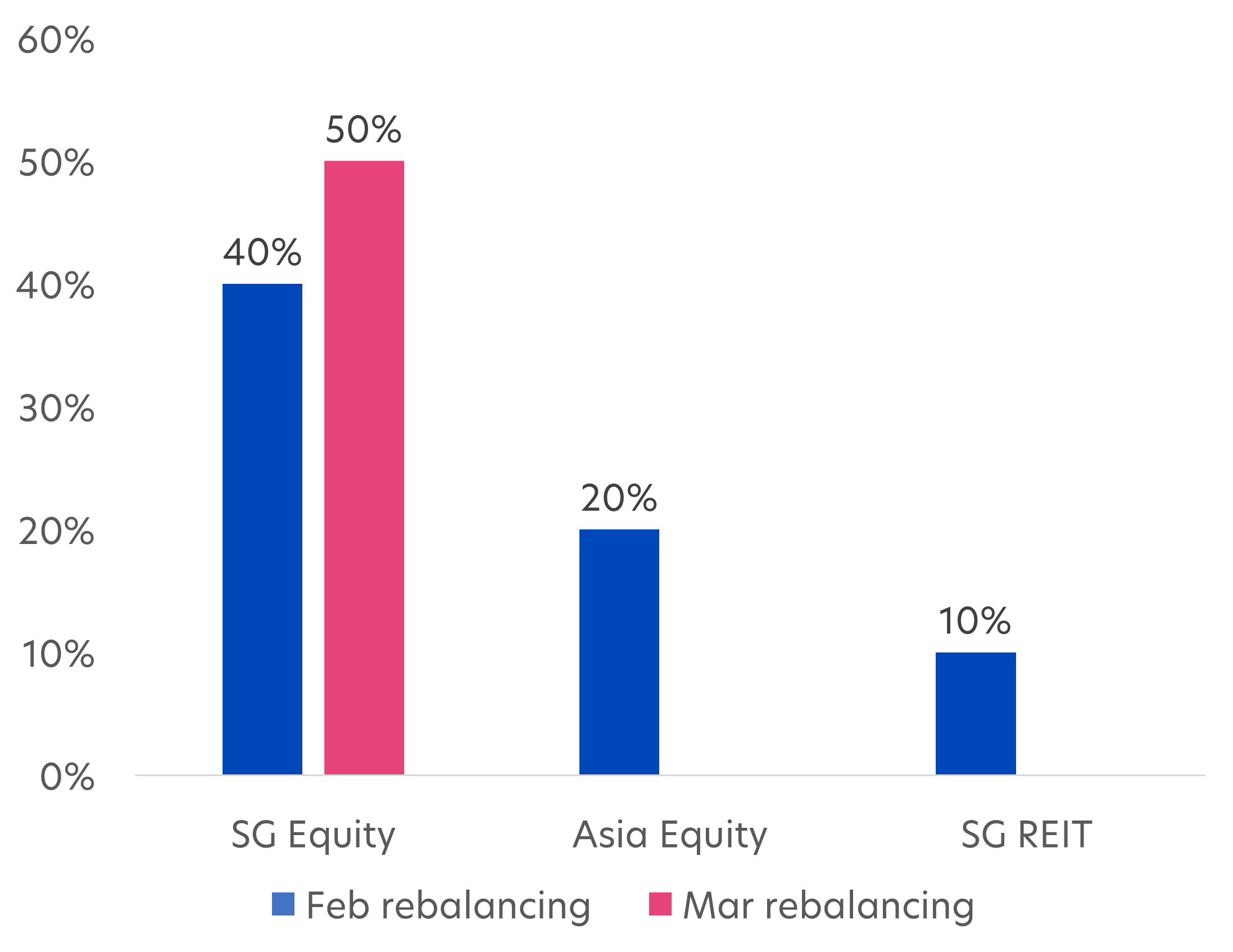
Source: UOBAM, as of 31 Mar 2026
Furthermore, this shift does not signal a negative long‑term view on Asia equities. Under the Fund’s dynamic framework, Asia exposure can be reintroduced when conditions stabilise, while remaining within the 20 percent cap.
Fixed income barbell
On the fixed income side, the Fund adopted a barbell structure during the March rebalancing:
- 10 percent cash
- 10 percent Singapore government bonds
- 30 percent money market instruments
Fig 2: Fund fixed income allocation post-rebalancing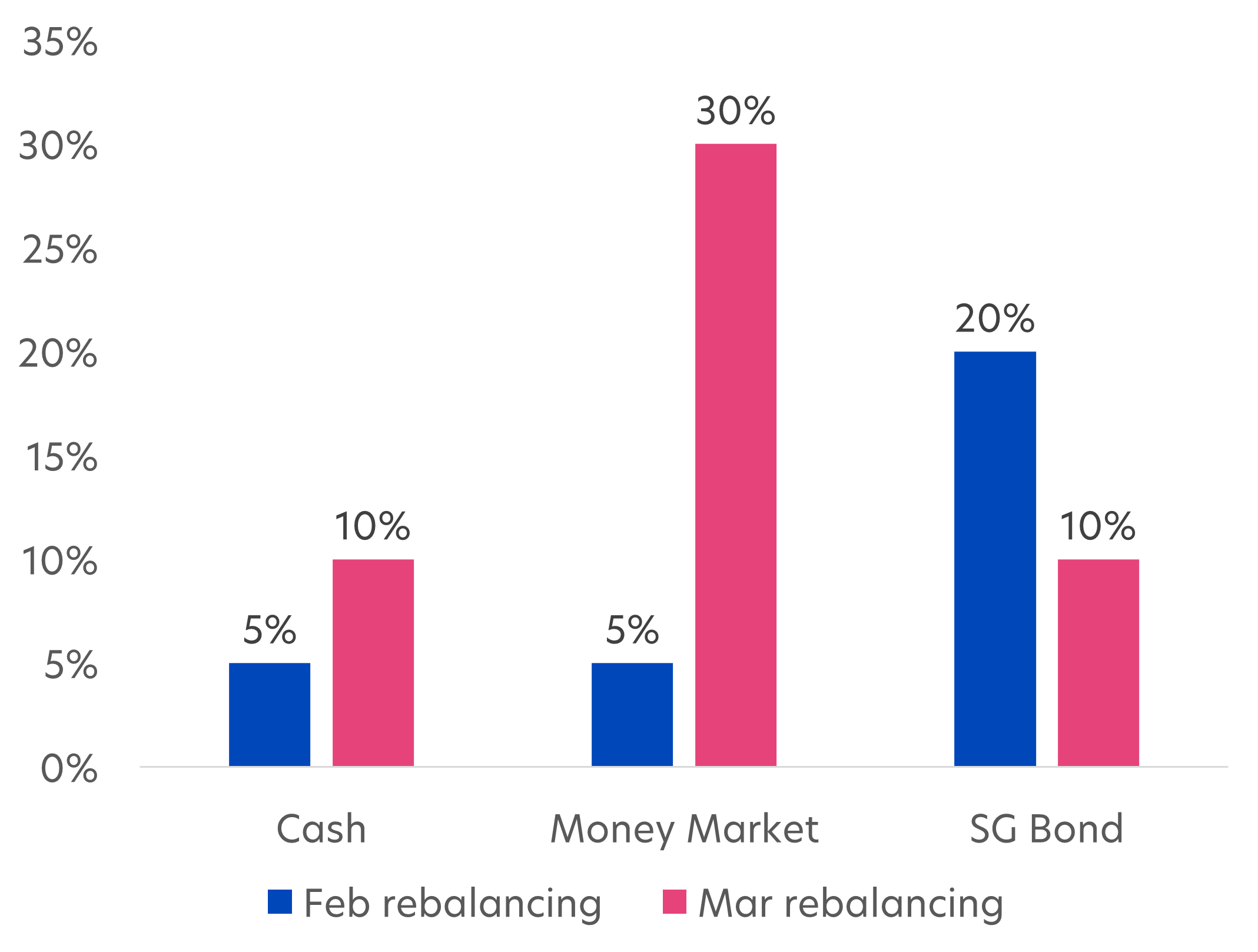
Source: UOBAM, as of 31 Mar 2026
In the current environment of rising yields and interest rate uncertainty, even government bonds can experience price volatility. Money market instruments such as MAS bills, which typically have very short maturities, are less sensitive to interest rate movements and offer greater stability, while still providing higher yields than cash. As a result, the Fund is currently overweight money market instruments, balancing defensiveness with income generation.
Portfolio in focus
Following the late-March rebalancing, the Fund’s top 10 holdings reflect its more defensive positioning heading into April.
Fig 3: Fund top 10 holdings, as of 31 Mar 2026
|
Name |
Weight (%) |
Description |
|
MAS Bill 05/04/26 |
19.9 |
Money market instrument |
|
ABF Singapore Bond Index Fund |
10.3 |
Basket of Singapore government bonds |
|
MAS Bill 04/06/26 |
8.5 |
Money market instrument |
|
MAS Bill 05/29/26 |
8.2 |
Money market instrument |
|
Keppel Ltd |
6.0 |
Conglomerate focused on infrastructure and urban development |
|
DBS Group |
4.6 |
Singapore’s largest bank |
|
First Resources |
3.7 |
Palm oil producer |
|
AIMS APAC REIT |
3.5 |
Industrial REIT |
|
Yangzijiang Shipbuilding |
3.1 |
Major shipbuilder focused on commercial vessels |
|
OCBC |
2.9 |
Leading Singapore bank |
Source: UOBAM, Morningstar, as of 31 Mar 2026.
Resilient YTD performance
The Fund has delivered a positive return of 1.2 percent in the year to date as of 31 March 2026, outperforming the benchmark. It has also outpaced the benchmark over longer horizons of six months and one year.
In the month of March, heightened market volatility led to a -5.7 percent return, largely reflecting market movements earlier in the month when the Fund remained overweight equities. This period underscores the importance of the Fund’s dynamic allocation framework in adjusting exposures as conditions evolve.
Fig 4: Fund returns as of 31 Mar 2026
|
Cumulative returns (%) |
||||
|
|
YTD |
1M |
6M |
1Y |
|
United SG Dynamic Income Fund |
1.2 |
-5.7 |
3.6 |
10.1 |
|
Benchmark |
0.7 |
0.2 |
1.5 |
3.4 |
Source: UOBAM, Morningstar, as of 31 Mar 2026. | Refers to United SG Dynamic Income Fund – Class A SGD Acc. Fund performance is calculated on a NAV to NAV basis, SGD basis, with dividends and distributions reinvested, if any. Performance figures for Year-to-Date show the percent change, while performance figures for 1-year show the average annual compounded returns. Past performance is not necessarily indicative of future performance. Fund inception date: 16 November 2023 | Does not include the effect of the current subscription fee that is charged, which an investor might or might not pay. | Benchmark: SORA Index + 2%
Takeaway
While a truce offers near‑term relief, uncertainty remains elevated given the lack of clarity over a lasting resolution. Income strategies therefore need to balance resilience with flexibility. Through its dynamic asset allocation framework, supported by AI insights and disciplined human oversight, the United SG Dynamic Income Fund is designed to adapt as conditions evolve while remaining anchored to the structural strengths of Singapore markets.
1Distributions are not guaranteed. Distributions may be made out of income, capital gains and/or capital. This relates to the disclosed distribution policy as set out in the Fund’s prospectus.
2Source: UOBAM, as of 31 Mar 2026
| If you are interested in investment opportunities related to the theme covered in this article, here is a UOB Asset Management Fund to consider: United SG Dynamic Income Fund
|
Distributions will be made in respect of the Distribution Classes of the Fund. Distributions are based on the NAV per unit of the relevant Distribution Class as at the last business day of the calendar month or quarter. The making of distributions is at the absolute discretion of UOBAM and that distributions are not guaranteed. The making of any distribution shall not be taken to imply that further distributions will be made. UOBAM reserves the right to vary the frequency and/or amount of distributions. Distributions from a fund may be made out of income and/or capital gains and (if income and/or capital gains are insufficient) out of capital. Investors should also note that the declaration and/or payment of distributions (whether out of income, capital gains, capital or otherwise) may have the effect of lowering the net asset value (NAV) of the relevant fund. Moreover, distributions out of capital may amount to a reduction of part of your original investment and may result in reduced future returns. Please refer to the Fund's prospectus for more information.
This document is for general information only. It does not constitute an offer or solicitation to deal in units in the Fund (“Units”) or investment advice or recommendation and was prepared without regard to the specific objectives, financial situation or needs of any particular person who may receive it. The information is based on certain assumptions, information, and conditions available as at the date of this document and may be subject to change at any time without notice. No representation or promise as to the performance of the Fund or the return on your investment is made. Past performance of the Fund or UOB Asset Management Ltd (“UOBAM”) and any past performance, prediction, projection or forecast of the economic trends or securities market are not necessarily indicative of the future or likely performance of the Fund or UOBAM. The value of Units and the income from them, if any, may fall as well as rise, and is likely to have high volatility due to the investment policies and/or portfolio management techniques employed by the Fund. Investments in Units involve risks, including the possible loss of the principal amount invested, and are not obligations of, deposits in, or guaranteed or insured by United Overseas Bank Limited (“UOB”), UOBAM, or any of their subsidiary, associate, or affiliate (“UOB Group”) or distributors of the Fund. The Fund may use or invest in financial derivative instruments, and you should be aware of the risks associated with investments in financial derivative instruments which are described in the Fund’s prospectus. The Fund may invest in capital instruments issued by Singapore incorporated financial institutions that are classified as Additional Tier 1 ("AT1") or Tier 2 ("T2") under MAS Notice 637 (or equivalent Regulations or Notices applicable to issuers of such instruments in Singapore, collectively, "risk based capital adequacy requirements"), which defines the regulatory requirements, eligibility criteria, and loss absorbency features of such instruments. AT1 and T2 instruments carry higher risks, including potential write down at the point of non viability, as specified under the respective risk-based capital adequacy requirements.
The UOB Group may have interests in the Units and may also perform or seek to perform brokering and other investment or securities-related services for the Fund. Investors should read the Fund’s prospectus, which is available and may be obtained from UOBAM or any of its appointed agents or distributors, before investing. You may wish to seek advice from a financial adviser before making a commitment to invest in any Units, and in the event that you choose not to do so, you should consider carefully whether the Fund is suitable for you. Applications for Units must be made on the application forms accompanying the Fund’s prospectus.
This advertisement has not been reviewed by the Monetary Authority of Singapore.
UOB Asset Management Ltd Co. Reg. No. 198600120Z