








Sustainable Investing Vision and Goals
At UOB Asset Management (UOBAM), our vision is to be a leading fund manager in sustainability in Asia. We have been a signatory to the United Nations-supported Principles for Responsible Investment (PRI) since 2020 and are also a signatory to the Singapore Stewardship Principles (SSP) for Responsible Investors.
With sustainability as a key strategic pillar, we focus on creating long-term value and positive impact for our stakeholders, while making sustainable investments accessible to all. We believe that the integration of ESG considerations into our investments contributes positively to risk mitigation and long-term performance.
Sustainability Investment Governance Structure
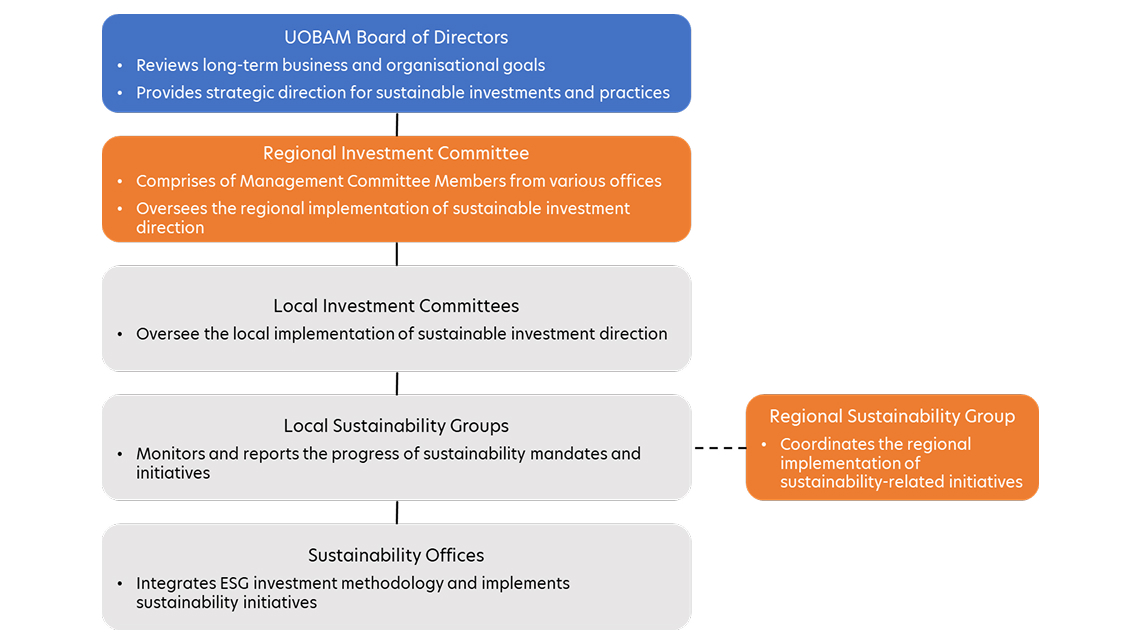
UOBAM’s sustainability investment governance structure provides oversight on our policies and initiatives. The UOBAM Board of Directors reviews long-term business and organisational goals and provides the strategic direction for our sustainable investments and practices. Management Committee members, who also make up the Regional Investment Committee, are responsible for implementation, with support from the Regional and Local Sustainability Groups, and Sustainability Offices.
Sustainable Investment Framework
As part of our commitment towards sustainability, we have put in place our sustainable investing policy as part of our sustainable investment framework, as set out in the table below.
| Sustainable Investment Framework | ||
|---|---|---|
| Sustainable Investing Strategies | Integration | Screening |
| ESG issues will be incorporated into existing investment practices using a combination of two approaches: integration and screening (where applicable in investment mandates) | ||
| UOBAM's Sustainable Investing Policy | ✓ | ✓ |
| Description | Systematically include ESG considerations in investment analysis and decisions, to better manage risks and improve returns | Application of filters to lists of potential investments to rule companies in or out of contention for investment, based on best-in-class and negative screening approaches |
We believe that ESG integration into our investment process, together with fundamental analysis, contributes to performance and risk mitigation by enabling us to identify high-quality companies which are resilient, well-managed, able to grow sustainably, and are likely to maintain their competitiveness in the long term.
Additionally, for selected sustainability funds, we utilise a combination of ESG integration, fundamental analysis, and our AI-augmentation model. UOBAM leverages investment-related technologies in a prudent way to enhance investment solutions and outcomes for our investors. Our proprietary AI-Augmentation model supplements our existing investment expertise and process with technology-driven analyses and insights. This is done through 3 implementation levels: screening (the model screens the investment universe to generate shortlists), selection (where analyst selections and ratings are incorporated into the model), and optimisation (where risk-constrained security/sector weights are added through an optimisation process).
Environmental Risk Management
UOB Asset Management (UOBAM) recognises that climate change is one of the most defining issues of our time. As asset managers, we acknowledge our responsibility in driving the transition toward a low-carbon economy for a resilient future. As such, UOBAM has incorporated environmental risk in the management of investor assets. The Environmental Risk Management Framework is part of UOBAM’s integral risk management framework and in line with UOB Group’s Environmental Risk Management Framework and the recommendations of the Task Force on Climate-Related Financial Disclosures (“TCFD”).
UOBAM’s Board of Directors is accountable for overall risk and the oversight of risk-taking activities in UOBAM. These include identifying environmental risks and opportunities over the short and long-term and evaluating the actual and potential impact of these risks and opportunities on UOBAM’s strategies, business plans and products.
UOBAM considers the following aspects of environmental risk:
- Physical risk, which arises from the impact of weather events and long-term or widespread environmental changes.
- Transition risk, which includes the implementation of regulatory policies, disruptive technological developments, and shifts in consumer and investor preferences.
- Reputational risk, which can arise at the firm level when asset managers invest into companies that carry out business activities that negatively impact the environment.
In addition to our Environmental Approach, UOBAM’s Portfolio Risk Management1 also includes the following:
- Environmental Risk Management: Identification, assessment and monitoring on individual investments and portfolios are conducted on a regular basis, with climate related data from a third-party data provider. Various metrics are used for risk identification and assessment which may include, but are not limited to, measuring carbon emissions and intensity and climate risk-related scenario analysis. This is conducted in line with the Guidelines set out by the Monetary Authority of Singapore (MAS) and the recommendations of the TCFD.
- Scenario Analysis: Conducted on a periodic basis as part of climate stress testing to further assess UOBAM’s portfolios’ environmental risk profile. The approach is based on climate scenarios provided by the International Energy Agency (IEA).
- Capacity Building: Raising awareness and equipping staff with the necessary skillsets on environmental risk management are conducted through relevant training sessions, via a combination of internal and external courses.
1With focus on selected sustainability funds
Approach to Sustainability Issues & Strategic Partnerships
UOBAM recognises the following non-exhaustive list of key sustainability issues, which are incorporated into our ESG scoring methodology for companies based on their materiality map classification. Our ESG controversy alert system also assists in the detection and monitoring of any ongoing corporate involvement in the following:
- Climate Change
- Corporate Governance
- Deforestation and Biodiversity Loss
- Health and Safety
- Human Capital and Labour Management
Strategic Partnerships
We look to take a proactive approach towards driving sustainable investing, in line with the PRI Principles, where our external efforts include establishing strategic investment partnerships with global sustainability leaders such as Robeco and Fukoku Capital Management.
Through such external partnerships, we aim to further enhance our capabilities and develop the accessibility of sustainable investment opportunities in Asia for investors. Examples include sustainability mandates, working together in policy consultation, and responsible investment education and thought leadership.

We use cookies to improve and customise your browsing experience. You are deemed to have consented to our cookies policy if you continue browsing our site.