Why ASEAN's blend of income, diversification and growth is attracting investor attention.
For years, investors have looked to Asia for growth. Rising incomes, rapid urbanisation and an expanding middle class have helped to drive the region's economic transformation.
But in today’s environment of rising geopolitical tensions and market uncertainty, investors are shifting their attention to more resilient income-generating assets such as bonds and dividend stocks.
Among these opportunities, ASEAN stands out. The region not only offers attractive dividend income, but also the potential to participate in Southeast Asia's ongoing economic growth. This makes ASEAN an increasingly compelling destination for income-focused investors.
Income is an important driver of returns in ASEAN
As ASEAN's economies mature, many of the region’s leading companies have developed strong cash-generating capabilities and established track records of distributing dividends to shareholders.
Banks, telco providers, utilities, infrastructure operators and consumer businesses have become important contributors to the region's dividend landscape. Many of these companies continue to benefit from structural growth trends while maintaining attractive payout policies.
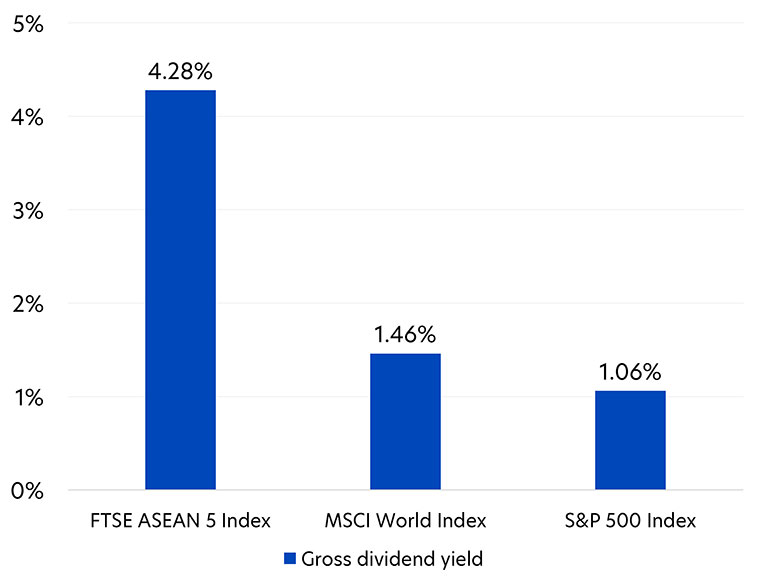
The numbers are compelling. The FTSE ASEAN 5 Index currently offers a gross dividend yield of 4.28 percent, almost four times higher than that of the MSCI World Index and S&P 500 Index1.
Fig 1: ASEAN offers a higher dividend yield than global and US markets
Source: Bloomberg, as of 1 Sep 2026
Even more notable is the role dividends have played in total returns. More than 60 percent of companies within the FTSE ASEAN 5 universe offer dividend yields above 3 percent, while dividends have historically accounted for approximately half of the index's total return over time 2.
Income without sacrificing growth
Unlike many traditional dividend markets, ASEAN remains one of the fastest-growing regions in the world3. Favourable demographics, rising consumption and continued investment from global companies continue to support economic growth across Southeast Asia.
This means investors are not simply collecting dividends. They are also gaining exposure to businesses that stand to benefit from long-term economic development.
Singapore for instance, is home to some of Asia's strongest financial institutions, while Malaysia and Thailand offer exposure to infrastructure, utilities and industrial champions. In Indonesia, growing financial penetration and rising household wealth continue to support the banking sector. Meanwhile, the Philippines presents opportunities linked to a young and growing consumer base.
The result is a compelling investment proposition: the potential to earn income while participating in the region's long-term growth story.
How to invest in ASEAN's dividend opportunities
The UOBAM Ping An FTSE ASEAN Dividend Index ETF (SGX: UPD, UPU) (the “ETF”) offers investors a convenient and cost-efficient way to access ASEAN's income potential. It provides exposure to leading dividend-paying companies across five key ASEAN markets and aims to distribute semi-annual income of at least 6 percent p.a. in 2026 and 20274.
Here’s what to know about the ETF.
Attractive dividend income potential For income-focused investors, the ETF aims to provide an enhanced dividend yield compared to the broader ASEAN market. To achieve this, its underlying index, the FTSE ASEAN ex REITs Target Dividend Index (the “Index”) allocates greater weight to companies with stronger dividend yields. As of 1 September 2026, the Index had a gross dividend yield of 6.31 percent compared to 4.28 percent for the FTSE ASEAN 5 Index5.
Dividend opportunities across ASEAN, not just Singapore Many Singapore investors naturally look to local stocks for dividends. The ETF goes a step further by providing exposure to dividend-paying companies across five key ASEAN markets: Singapore, Malaysia, Indonesia, Thailand and the Philippines.
This broader approach allows investors to tap into a wider opportunity set of dividend-paying companies while reducing reliance on any single market. In fact, Singapore accounts for only around 26 percent of the ETF6, with the remainder invested across other ASEAN economies.
As shown below, the ETF includes many of ASEAN's established dividend-paying businesses, including banks, telco operators and infrastructure companies.
Fig 2: ETF Top 10 holdings
Company
Description
Weight (%)
DBS Group
Singapore’s largest bank and financial group
14.14%
SCB X
Thailand’s major financial group
10.36%
Metropolitan Bank & Trust
One of Philippines’ largest banks
5.87%
Digital Telecommunications Infrastructure Fund
Thailand's first telecommunication infrastructure fund
5.20%
Malayan Banking (Maybank)
Malaysia’s largest bank and financial services group
5.07%
Bank Rakyat Indonesia
Indonesia’s leading microfinance and retail bank
4.87%
Bank Mandiri
Indonesia’s largest state-owned commercial bank
4.84%
PTT
Thailand’s national energy and petrochemicals company
4.64%
PTT Exploration & Production
PTT subsidiary focused on oil and gas exploration and production
3.46%
United Overseas Bank
One of Singapore’s largest banks
3.33%
Source: UOBAM, as of 30 Sep 2026
A potential stabiliser for growth-heavy portfolios Many investors today already have significant exposure to US tech stocks and other growth-oriented investments. The UOBAM Ping An FTSE ASEAN Dividend Index ETF offers something different: exposure to established dividend-paying businesses across ASEAN.
Around 78 percent of the portfolio is invested in sectors traditionally associated with income and stability, including financials, telecommunications, utilities and consumer staples7. These businesses typically benefit from strong market positions, generate recurring cash flows and have established track records of paying dividends.
As a result, the ETF can serve as a useful complement to portfolios that are concentrated in US tech and other growth sectors. Historically, ASEAN equities have experienced lower volatility than US equities, with the FTSE ASEAN ex REITs Target Dividend Index, the ETF’s benchmark, posting a five-year volatility of 9.5 percent compared with 15.7 percent for the FTSE USA Index8.
Compelling valuations offer potential upside Compared with the US, valuations across ASEAN markets like Indonesia, Malaysia and the Philippines look attractive, and are currently sitting below their 10-year averages9.
Part of this is attributable to investors’ strong preference in recent years for US tech and AI-related companies, which has left many ASEAN markets overlooked despite solid economic growth and corporate earnings fundamentals. As a result, investors today can gain exposure to established, dividend-paying businesses at valuations that remain attractive relative to many developed markets.
This means that as ASEAN economies continue to expand and corporate earnings grow, investors may benefit from two potential drivers of return: regular dividend income and capital appreciation.
1Source: Bloomberg, as of 1 Sept 2026 2Source: FTSE Russell, as of 31 Aug 2026 3Source: World Economic Forum, Dec 2025 4Distributions (in SGD) are not guaranteed. Distributions may be made out of income, capital gains and/or capital. This relates to the disclosed distribution policy as set out in the Fund's prospectus. 5Source: Bloomberg, as of 1 Sep 2026 6Source: UOBAM, as of 30 Sep 2026 7Source: UOBAM, as of 30 Sep 2026 8Source: FTSE Russell, as of 30 Sep 2026 9Source: UOBAM, Factset, as of 31 Aug 2026. Based on forward P/E ratios
Important notice and disclaimers
MSCI Data are exclusive property of MSCI. MSCI Data are provided “as is”, MSCI bears no liability for or in connection with MSCI Data. MSCI full disclaimer at msci.com/notice-and-disclaimer-for-reporting-licenses.
This document is for general information only. It does not constitute an offer or solicitation to deal in units in the Fund (“Units”) or investment advice or recommendation and was prepared without regard to the specific objectives, financial situation or needs of any particular person who may receive it. The information is based on certain assumptions, information, and conditions available as at the date of this document and may be subject to change at any time without notice. No representation or promise as to the performance of the Fund or the return on your investment is made. Past performance of the Fund or UOB Asset Management Ltd (“UOBAM”) and any past performance, prediction, projection or forecast of the economic trends or securities market are not necessarily indicative of the future or likely performance of the Fund or UOBAM. The value of Units and the income from them, if any, may fall as well as rise, and is likely to have high volatility due to the investment policies and/or portfolio management techniques employed by the Fund. Investments in Units involve risks, including the possible loss of the principal amount invested, and are not obligations of, deposits in, or guaranteed or insured by United Overseas Bank Limited (“UOB”), UOBAM, or any of their subsidiary, associate, or affiliate (“UOB Group”) or distributors of the Fund. The Fund may use or invest in financial derivative instruments, and you should be aware of the risks associated with investments in financial derivative instruments which are described in the Fund’s prospectus. The Fund may invest in capital instruments issued by Singapore incorporated financial institutions that are classified as Additional Tier 1 ("AT1") or Tier 2 ("T2") under MAS Notice 637 (or equivalent Regulations or Notices applicable to issuers of such instruments in Singapore, collectively, "risk based capital adequacy requirements"), which defines the regulatory requirements, eligibility criteria, and loss absorbency features of such instruments. AT1 and T2 instruments carry higher risks, including potential write down at the point of non-viability, as specified under the respective risk-based capital adequacy requirements. The UOB Group may have interests in the Units and may also perform or seek to perform brokering and other investment or securities-related services for the Fund. Investors should read the Fund’s prospectus, which is available and may be obtained from UOBAM or any of its appointed agents or distributors, before investing. You may wish to seek advice from a financial adviser before making a commitment to invest in any Units, and in the event that you choose not to do so, you should consider carefully whether the Fund is suitable for you. Applications for Units must be made on the application forms accompanying the Fund’s prospectus.
This advertisement has not been reviewed by the Monetary Authority of Singapore.