United SGD Fund: Your defensive anchor in an uncertain world
Fund Focus
23 Sep 2026
4 mins read
You are now reading:
United SGD Fund: Your defensive anchor in an uncertain world
2026 has been a good year for equity investors so far. Despite geopolitical tensions, higher oil prices and rising Treasury yields, global equities have remained resilient, continuing to climb despite a challenging macroeconomic backdrop. However, a hawkish rate hike by the US Federal Reserve (Fed), along with ongoing concerns over inflation and higher government bond yields, may weigh on equities in the near term. Investors who have benefited from strong market gains in recent times may therefore wish to adopt a more defensive stance and prioritise capital preservation until greater clarity emerges.
A stabilising allocation for portfolios
In periods characterised by heightened uncertainty and elevated market volatility, liquidity and stability become increasingly valuable. Rather than taking on additional risk in pursuit of returns, investors may find merit in allocating a portion of their portfolios to high-quality short-term bonds that can provide income while offering flexibility to navigate changing market conditions.
Against this backdrop, the United SGD Fund (the “Fund”) can play a defensive role within a diversified portfolio. By investing in high-quality, short-term investment grade bonds, the Fund seeks to offer capital stability, consistent returns, and attractive income. As of 31 August 2026, the Fund had a yield to maturity of 3.37 percent1. Meanwhile, its short duration focus also offers investors greater flexibility to navigate changing expectations around interest rates. Taken together, this makes the Fund a suitable parking place for investors who prefer to stay cautious while awaiting clearer signals on the direction of financial markets.
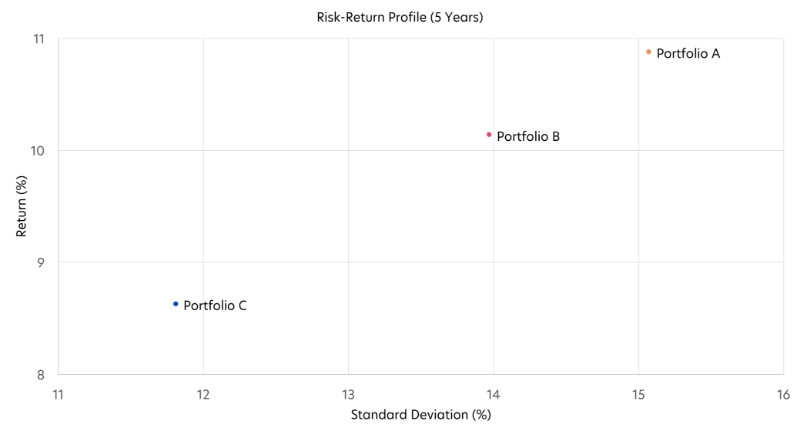
Importantly, the Fund also serves as a strong defensive anchor for portfolios. As illustrated below, adding the Fund to a portfolio of global equities has historically reduced overall portfolio volatility. Increasing the allocation to the Fund from 0 percent to 10 percent and then 30 percent progressively reduced portfolio volatility over a five-year period, with standard deviation falling from around 15 percent to below 12 percent.
Fig 1: Diversifying an equity portfolio with a short duration bond fund can help reduce portfolio volatility
Portfolio
World Equities
United SGD Fund
Portfolio A
World Equities, 100%
United SGD Fund, 0%
Portfolio B
World Equities, 90%
United SGD Fund, 10%
Portfolio C
World Equities, 70%
United SGD Fund, 30%
Source: Morningstar, as of 31 August 2026. World Equities is represented by the MSCI All Country World Index. United SGD Fund is represented by the United SGD Fund Class A SGD Acc, in SGD terms, on a NAV basis, with dividends and distributions reinvested, if any. Performance figures for 1 month till 1 year show the percent change, while performance figures above 1 year show the average annual compounded returns.
The trade-off is that lower portfolio volatility was accompanied by lower historical returns as the allocation to equities declined. Yet, portfolio resilience can be valuable during periods of market stress, as reducing the magnitude of portfolio fluctuations can help investors remain focused on their longer-term financial goals.
In short, a defensive allocation may therefore serve two important purposes: potentially improving risk-adjusted returns through diversification, and helping investors stay invested during periods of market volatility by reducing the impact of short-term market movements on the portfolio.
How does the United SGD Fund deliver stability?
The Fund’s role as a stabilising allocation stems from two key characteristics: its short duration profile and its defensive positioning.
1. The value of keeping duration short
When government bond yields rise, bond prices typically fall, creating short-term mark-to-market pressure even if credit fundamentals remain unchanged. The longer the duration of a bond portfolio, the greater its sensitivity to changes in yields.
As of 31 August 2026, the Fund had a duration of 1.76 years, significantly shorter than the 8.31 years for its Morningstar peer group. This shorter-duration profile can offer three key benefits across different market environments:
Lower interest-rate sensitivity, helping to limit the impact of rising yields on bond prices
Ability for faster reinvestment into higher-yielding securities as bonds mature
Lower net asset value (NAV) volatility relative to longer-duration fixed income strategies
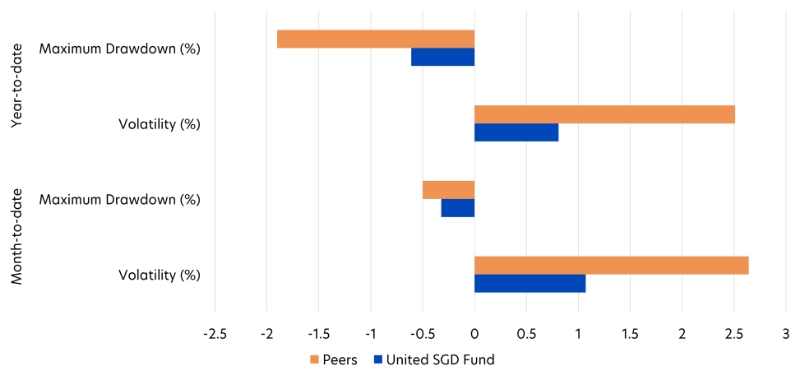
Illustrating the above benefits, data shows that the Fund has recorded lower volatility and a smaller maximum drawdown than its Morningstar peer group on a month-to-date and year-to-date basis.
Fig 2: United SGD Fund volatility and maximum drawdown vs Morningstar peer group
Source: Morningstar, as of 13 September 2026. Past performance is not necessarily indicative of future performance. Fund performance is based on United SGD Fund Class A SGD Acc, in SGD terms, on a NAV basis, with dividends and distributions reinvested, if any. Fund performance is net of fees. Morningstar peer group refers to Morningstar SGD Bond Fund category.
The Fund has also delivered more resilient performance than its longer duration peers over the same period, highlighting its stability and lower interest rate sensitivity.
Fig 3: United SGD Fund performance vs Morningstar peer group
Month-to-date
Year-to-date
United SGD Fund
-0.32%
0.18%
Peers
-0.50%
-0.05%
Source: Morningstar, as of 13 September 2026. Past performance is not necessarily indicative of future performance. Fund performance is based on United SGD Fund Class A SGD Acc, in SGD terms, on a NAV basis, with dividends and distributions reinvested, if any. Fund performance is net of fees. Morningstar peer group refers to Morningstar SGD Bond Fund category.
2. The foundations of stability
Short duration is only one part of the Fund’s defensive profile. Its emphasis on high-quality, investment-grade bonds and exposure to resilient sectors help to keep the Fund stable and defensive. The Fund is well diversified across sectors such as financials, industrials, consumer discretionary, real estate and utilities, areas where companies generally have stronger balance sheets and more stable cashflows.
The quality of the portfolio is reflected in its average credit rating of BBB+2, reflecting the Fund’s investment-grade focus. Combined with diversified, defensive positioning, these characteristics have contributed to the Fund’s lower volatility compared with selected short-duration peer funds with a significant local presence. Over the past three years, the Fund has recorded annualised volatility of 0.83 percent, below the peer range of 0.92 to 1.08 percent. It also recorded a smaller maximum drawdown than the selected peer group, as shown below.
Fig 4: United SGD Fund risk metrics relative to selected short duration peers
United SGD Fund
Selected peers
3-year annualised volatility
0.83%
0.92% to 1.08%
3-year maximum drawdown
-0.50%
-0.55% to -0.68%
Source: Morningstar, as of 31 August 2026. Past performance is not necessarily indicative of future performance. Fund performance is based on United SGD Fund Class A SGD Acc, in SGD terms, on a NAV basis, with dividends and distributions reinvested, if any. Fund performance is net of fees. Selected peers chosen based on similar investment style, operational size and degree of local presence.
Impact of higher yields on the Fund
Historically, higher starting yields have provided a stronger foundation for medium-term returns, as coupon income and reinvestment income become increasingly important contributors to total return. While short-term performance may deviate from yield-to-maturity due to mark-to-market movements, particularly during periods of rapid interest rate repricing such as in 2026, the current yield profile offers investors a more attractive carry cushion than in previous years.
Given the Fund’s short-duration profile, the portfolio can redeploy proceeds from maturing bonds relatively quickly into higher-yielding opportunities. This allows investors to benefit from the current elevated yield environment should interest rates remain higher for longer. As a result, investors in the Fund can take comfort in the fact that although higher yields have created short-term mark-to-market pressure, the increase in yields this year has also enhanced the portfolio’s future income-generating capacity, as maturing bond proceeds are reinvested at higher yields.
Pedigree and track record
As one of Singapore’s longest-established SGD fixed income funds, the Fund has built a sizeable asset base of S$3.58 billion3 and a track record spanning 28 years. Since its inception in 1998, it has experienced only two negative calendar years and has had no defaults.
Looking ahead
While near-term uncertainty may persist, the combination of healthy corporate fundamentals, supportive market technicals and continued demand for high-quality Asian credits should provide a constructive backdrop for the United SGD Fund over the medium term.
1Source: Morningstar, UOBAM, as of 31 August 2026. Yield is computed based on the weighted average yield-to-maturity of the Fund’s holdings and is not guaranteed. 2Source: UOBAM, as of 31 August 2026 3Source: Morningstar, UOBAM, as of 31 August 2026
Important notice and disclaimers
MSCI Data are exclusive property of MSCI. MSCI Data are provided “as is”, MSCI bears no liability for or in connection with MSCI Data. MSCI full disclaimer here.
This document is for general information only. It does not constitute an offer or solicitation to deal in units in the Fund (“Units”) or investment advice or recommendation and was prepared without regard to the specific objectives, financial situation or needs of any particular person who may receive it. The information is based on certain assumptions, information, and conditions available as at the date of this document and may be subject to change at any time without notice. No representation or promise as to the performance of the Fund or the return on your investment is made. Past performance of the Fund or UOB Asset Management Ltd (“UOBAM”) and any past performance, prediction, projection or forecast of the economic trends or securities market are not necessarily indicative of the future or likely performance of the Fund or UOBAM. The value of Units and the income from them, if any, may fall as well as rise, and is likely to have high volatility due to the investment policies and/or portfolio management techniques employed by the Fund. Investments in Units involve risks, including the possible loss of the principal amount invested, and are not obligations of, deposits in, or guaranteed or insured by United Overseas Bank Limited (“UOB”), UOBAM, or any of their subsidiary, associate, or affiliate (“UOB Group”) or distributors of the Fund. The Fund may use or invest in financial derivative instruments, and you should be aware of the risks associated with investments in financial derivative instruments which are described in the Fund’s prospectus. The Fund may invest in capital instruments issued by Singapore incorporated financial institutions that are classified as Additional Tier 1 ("AT1") or Tier 2 ("T2") under MAS Notice 637 (or equivalent Regulations or Notices applicable to issuers of such instruments in Singapore, collectively, "risk based capital adequacy requirements"), which defines the regulatory requirements, eligibility criteria, and loss absorbency features of such instruments. AT1 and T2 instruments carry higher risks, including potential write down at the point of non-viability, as specified under the respective risk-based capital adequacy requirements. The UOB Group may have interests in the Units and may also perform or seek to perform brokering and other investment or securities-related services for the Fund. Investors should read the Fund’s prospectus, which is available and may be obtained from UOBAM or any of its appointed agents or distributors, before investing. You may wish to seek advice from a financial adviser before making a commitment to invest in any Units, and in the event that you choose not to do so, you should consider carefully whether the Fund is suitable for you. Applications for Units must be made on the application forms accompanying the Fund’s prospectus.
This advertisement has not been reviewed by the Monetary Authority of Singapore.