You are now reading:
Market volatility: Stay calm, stay invested

Tel:
• 6532 7988
Complaint Management
• Hotline: 1800 22 22 228
• Calling from overseas: +65 6222 2228
Tel:
• 6532 7988
Complaint Management
• Hotline: 1800 22 22 228
• Calling from overseas: +65 6222 2228
Tel:
• 6532 7988
Complaint Management
• Hotline: 1800 22 22 228
• Calling from overseas: +65 6222 2228
Tel:
• 6532 7988
Complaint Management
• Hotline: 1800 22 22 228
• Calling from overseas: +65 6222 2228

you are in UOB Asset Management


You are now reading:
Market volatility: Stay calm, stay invested
For many investors, market volatility can feel deeply unsettling. Watching the value of your portfolio fall can be frustrating and unnerving, especially when headlines are dominated by negative news.
In moments like these, it can be tempting to move to cash and wait out the volatility. Yet, history shows that acting on these emotions at the wrong time can often do more harm than the market decline itself.
Before making any investment decisions, it can be helpful to remember that market uncertainty is part and parcel of investing. While markets experience pullbacks from time to time, they have generally recovered and trended upwards over the long term. More often than not, the biggest challenge is not the market's ups and downs, but how you respond to them.
Here are 3 ways to help you navigate market ups and downs with greater confidence.
Events such as geopolitical tensions, shifting interest rate expectations and policy changes can trigger market swings. Against a backdrop of relentless news coverage and market commentary about what could happen next, you may feel pressured to take action by reducing risk or selling your investments altogether.
But it’s worth remembering that markets can often prove more resilient than expected. Events such as the COVID pandemic in 2020, the interest rate hiking cycle in 2022, tariff-related fears in 2025, and Middle East tensions in 2026 all triggered periods of market turbulence. Yet over time, markets recovered, recouped their losses and went on to reach new highs.
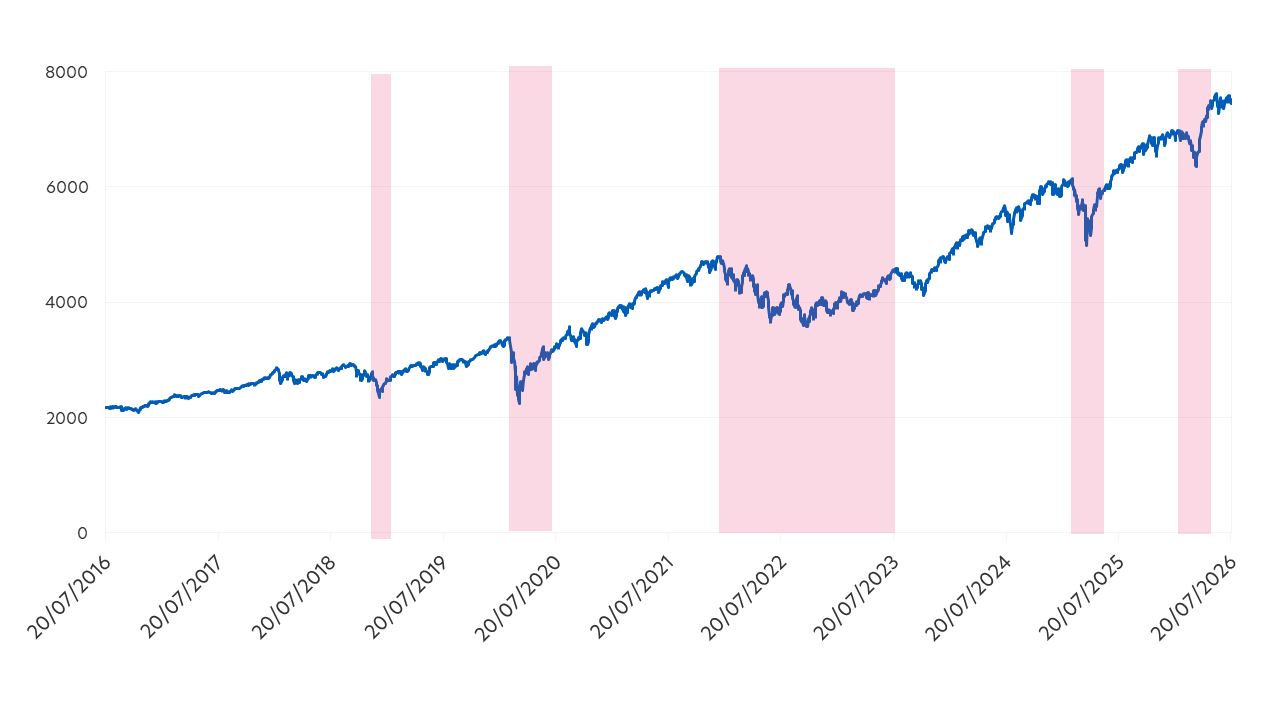
Source: Bloomberg, 10-year S&P 500 data as of 21 July 2026
The key takeaway is that staying calm and doing nothing can often be the best course of action. By avoiding knee-jerk decisions and maintaining a long-term perspective, you may be less likely to make investment choices that you later regret.
While market declines can be painful, the bigger risk for many investors is being on the sidelines when markets begin to recover.
Many investors think that it’s better to sit out the market's worst days and wait until conditions stabilise before investing again. This approach may sound sensible, but it’s usually difficult to execute in practice. After all, you need to be right twice in order to time the market successfully: first on when to exit, and then on when to re-enter.
This is easier said than done because some of the strongest market rebounds have occurred shortly after the steepest declines. If you sell during periods of market stress, you not only lock in losses, but also risk missing the recovery that typically follows.
| Event | Largest down day | Largest down day |
| COVID pandemic | 16 Mar 2020 (-12.0%) |
24 Mar 2020 (+9.4%) |
| Inflation & rate hike fears | 13 Sep 2022 (-4.3%) |
10 Nov 2022 (+5.5%) |
| Tariff shock | 4 Apr 2025 (-6.0%) |
9 Apr 2025 (+9.5%) |
| Start of US-Iran conflict | 20 Jan 2026 (-2.1%) |
31 Mar 2026 (+2.9%) |
Source: Bloomberg, based on S&P 500 returns. Illustrative example of market behaviour.
Furthermore, research shows that missing the market’s strongest recovery days can impact long-term returns. If you missed just the 10 best trading days over the past 20 years, the value of your portfolio could be almost 50 percent lower than if you had remained invested throughout . This highlights how costly it can be to move to the sidelines in an attempt to avoid short-term market volatility.
Looking at it another way, periods of uncertainty can also create opportunities. Historically, some of the most attractive long-term entry points have emerged when investor sentiment was at its weakest and market fears were at their highest. While no one can predict exactly when markets will turn, staying invested allows you to participate in any subsequent recovery and benefit from the market's long-term growth potential.
The next time choppy markets make you queasy, it may help to revisit the reasons you invested in the first place. Ask yourself:
If the answers to these questions remain largely the same, short-term market fluctuations alone should not dictate your investment decisions.
Markets will likely continue to move up and down from here. While no one can predict what comes next, staying focused on your goals, maintaining a long-term perspective and avoiding emotional decisions can help you navigate uncertainty with greater confidence.
For investors who find it difficult to determine the right time to invest, a Regular Savings Plan (RSP) can help take market timing out of the equation. By investing a fixed amount at regular intervals, you can build your portfolio gradually rather than trying to pick the perfect entry point.
This approach, often referred to as dollar-cost averaging, allows you to invest consistently across different market conditions. It can also help reduce the emotional pressure of deciding when to invest, while keeping you focused on your long-term financial goals.
Ultimately, investment success often comes not from predicting what happens next, but from staying invested long enough to benefit when opportunities emerge.

07 Jul 2026 • 4 mins read

11 Mar 2026 •