


You are now reading:
Asia turns the tables on dividends

Tel:
• 6532 7988
Complaint Management
• Hotline: 1800 22 22 228
• Calling from overseas: +65 6222 2228
Tel:
• 6532 7988
Complaint Management
• Hotline: 1800 22 22 228
• Calling from overseas: +65 6222 2228
Tel:
• 6532 7988
Complaint Management
• Hotline: 1800 22 22 228
• Calling from overseas: +65 6222 2228
Tel:
• 6532 7988
Complaint Management
• Hotline: 1800 22 22 228
• Calling from overseas: +65 6222 2228

you are in UOB Asset Management


You are now reading:
Asia turns the tables on dividends
The global dividend landscape is evolving. Rounding out our Asia series, we look at why Asian companies, especially those in ASEAN, have emerged as a reliable source of income, with dividend payouts that increasingly surpass those of their global counterparts.
Just a decade ago, investing in Asian companies often meant not only higher volatility but also lower dividends. But in recent years, many developed market corporates have opted not to distribute their excess capital back to shareholders.
In the US, assuming limited acquisition opportunities, corporates buybacks have become a preferred means of dealing with cash windfalls. This is more tax-efficient for US shareholders and allows companies to avoid over-committing to high dividends. Meanwhile European corporates, faced with increased trading and geopolitical uncertainties, are often keen to retain more capital.
As a result, the S&P 500’s average dividend payout ratio has dropped dramatically over the past 10 years from 40 percent to 30 percent. The EuroStoxx 50’s payout ratio, although still relatively high, has also dropped steeply from 61 percent to 48 percent over the same period.
By contrast, the average for the MSCI Asia Pacific ex Japan index has remained steady at close to 40 percent. This consistency has been driven in part by a change in investor attitudes, with investors increasingly in search of income, and shareholders favouring higher dividend payouts. Asian regulators have also realigned their reporting requirements by throwing more light on dividends-based capital efficiency and shareholder value.
This in turn is helping to stabilise the returns of Asian stocks that are dividend-focused. About two thirds of the Asian stock market’s total returns now come from dividends, compared to one third for the S&P 500. So, it is not surprising that over the long term, such stocks tend to provide a higher total return to investors than the wider market.
Nowhere in Asia is the drive to enhance dividends more evident than in ASEAN. Over the past 10 years, the average dividend yield offered by the North Asian markets like China, Taiwan and Korea has held steady at around 2 percent, whereas the average offered by ASEAN companies is almost double that.
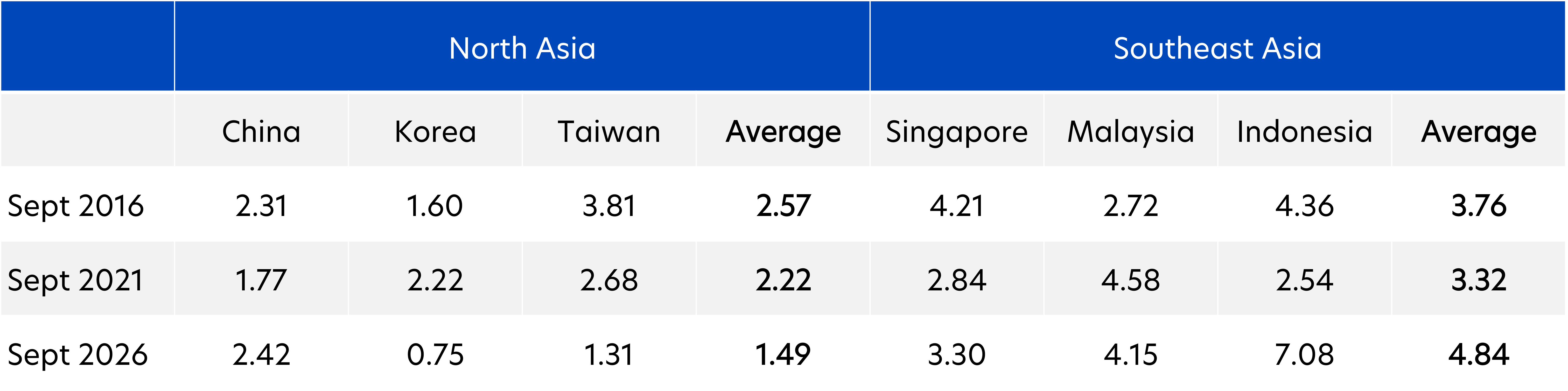
Source: MacroMicro, retrieved October 2026. Based on respective MSCI indices
In order to understand ASEAN’s dividend yield story, it is necessary to dive deep into the region’s financial services sector. Financials comprise over two thirds of most ASEAN high dividend yield indices, and mainly features the region’s large commercial banks.
DBS Group has traditionally offered attractive dividend yields of between 4 – 6 percent. The current and forward dividend yield is at the lower end of this range, but there is no doubting the bank’s solid financial track record. The bank has a history of rewarding shareholders via ordinary dividends and supplementary capital returns.
Bank Rakyat Indonesia is another example of a high dividend paying stock, with dividend yields having tripled over the past decade from around 3 to 10 percent. Such levels do not look sustainable over the long term and reflect a very high payout ratio of roughly 90 percent of profits. The ratio looks likely to fall back to around 60 percent, but this would still represent a healthy yield.
Malayan Banking (Maybank)’s current dividend yield of 6.1 percent looks high relative to other Asian banks. In fact, the bank has delivered 5 to 6 percent dividend yields since 2012. As Malaysia’s largest listed company, Maybank is able to generate steady earnings and has long been known for its steadfast dividend distribution policy, including a plan that allows dividends to be reinvested at a discount.
Of the remaining one third of ASEAN’s high dividend stocks, these can be separated into three key groupings:
CapitaLand Ascendas REIT (CLAR) is a wholly owned subsidiary of CapitaLand Investment Limited, one of the largest real estate investment managers in the region. About 13 percent of the portfolio is invested in AI datacentres across Singapore, Europe and Japan and it is a good example of new opportunities within the sector. The company’s forward dividend yield is 6.9 percent, and its long-term average is a lower but still respectable 5.3 percent.
PTT is a Thai state-owned petroleum and petrochemical company with business interests around the world. Given current high energy prices, the company posted a record high net income in 1H 2026. Its current and forward dividend yield is an attractive 6.8 percent, with a five-year average of 5.9 percent. This, however, may adjust downwards once oil prices stabilise, and fairly large dividend fluctuations have been recorded in the past.
Hap Seng Plantations, like other Malaysian plantation stocks, may not appear to be an exciting counter to invest in. However, palm oil is in demand as a biodiesel alternative to petroleum oil. These higher prices coupled with rising output is helping the company to quietly accumulate cash. As a result, Hap Seng’s dividend yield currently standing at around 3.2 percent, could rise to 5.2 percent according to forward projections.
ASEAN equity markets tend to march to the beat of their own drums. Although physically well integrated into global electronics and semiconductor supply chains, the region still demonstrates a surprisingly low financial correlation to global benchmarks and tech-heavy indices.
This can be explained by the fact that the region retains its high concentration of value-focused and cash-centric companies. As such, ASEAN offers investors a unique reason to be included in portfolios. It is not only able to serve as a buffer against global AI and tech bubbles but also becomes a good source of income during such periods of volatility.

07 Oct 2026 • 5 mins read

09 Oct 2026 • 6 mins read